WeHamd Technologies Private Limited (WEHAMD) is an AI product company in Hyderabad, India, building enterprise AI agents, healthcare research software, and digital verification tools.
Select a product to review its purpose, maturity, and current product surface.
PRODUCT EXPLORER
01 / 05
Active developmentAI business operating system
Hamd
Coordinate knowledge, agents, and approvals in one workspace.
Hamd connects authenticated AI chat, document and presentation agents, human approvals, and web and mobile workspaces.
Chief of Staff chat
Document agents
Approval workflows
Core workflows are operational. The broader platform is being built.
H
Hamd workspaceKNOWLEDGE · AGENTS · APPROVALS
Active development
01 · GROUNDCompany knowledge
Approved documents and workspace context.
02 · PREPARESpecialist agents
Draft work with sources and visible reasoning.
03 · APPROVEHuman checkpoint
Review consequential output before action.
HAMD PRODUCT EVIDENCE
Hamd across the mobile experience and operating platform.
The iOS recording shows the health product supplied by WeHamd. The capability inventory below reflects the separate Hamd OS codebase and its current implementation status.
Implemented Requires configuration In development
HAMD IOS PRODUCT DEMO
A health workspace built around conversation and context.
The recording shows Hamd guiding health questions, visit preparation, personal records, reports, activity, medicines, and care-planning tasks in one private mobile experience.
Experience
Conversational health
Context
Records + local workspace
Surfaces
Care + activity + safety
Product recording supplied by WeHamd. Demo content is shown and must not be interpreted as medical advice or a clinical result.
Hamd iOS product recording · 00:27
ExperienceWeb + mobile
GatewayIdentity + task API
RuntimeOrchestration + events
IntelligenceAgents + model routing
OutputArtifacts + pull requests
OperationsData + observability
01Chief of Staff
Implemented
Conversational task control
Create work through chat, follow the real planning and routing trail, and receive the final result in the same conversation.
Markdown responses
Live task trail
Conversation history
02Orchestration
Implemented
Intent-based agent routing
A LangGraph workflow classifies each request, selects an appropriate specialist, persists the run, and reports durable status events.
Intent classification
Agent dispatch
Durable task events
03Approvals
Implemented
Human review before completion
Generated files and coding pull requests remain awaiting approval until a person reviews the actual artifact or opens the pull request.
Approval queue
Owned downloads
Pull request review
04Studio
Implemented
Owned artifact library
Documents, presentations, and generated images are stored per owner, listed in Studio, previewed in-app, and downloaded with authentication.
DOCX generation
PPTX generation
SVG generation
05Projects
Implemented
Work organised around real tasks
Project status and progress are derived from persisted tasks rather than invented milestones, with chat requests optionally scoped to a project.
Project creation
Task-derived progress
Project-scoped chat
06Software
Configuration dependent
Coding solutions and pull requests
The coding agent produces an implementation-ready solution and can commit it to a task document on a GitHub pull request when an account is linked.
Reasoning model route
GitHub OAuth
Branch and PR creation
07Memory
Configuration dependent
Semantic recall across completed work
Successful tasks can be embedded into an owner-scoped vector store so the Chief of Staff can recall relevant earlier requests in later work.
Qdrant memory
Local embeddings
Owner-scoped recall
08Models
Implemented
Provider-independent model routing
Agents use one interface across OpenAI, Anthropic, DeepSeek, Kimi, and local Qwen, with explicit failure handling and ordered fallback.
Provider fallback
Local model option
Coding-specific route
09Mobile
Implemented
Tasks available beyond the desktop
The Flutter client supports authenticated chat, live task status, task details, pull request access, and generated artifact downloads.
Chief of Staff chat
Live status
Task detail
10Platform
Implemented
Observable service architecture
Gateway, authentication, and orchestration services expose metrics for request rate, errors, latency, and work in progress.
Prometheus metrics
Grafana dashboard
Service health
11Security
Implemented
Protected data and service boundaries
The gateway validates tokens, enforces request limits, keeps internal services private, and serves artifacts only to their owner.
JWT validation
Rate limits
Owner-only artifacts
12Expansion
In development
Broader operating surfaces
Agent management, the full Software Factory, most executive dashboards, uploads, and richer media workflows remain active product work.
Agent management
Executive dashboard
Media workflows
AAFIYA PRODUCT EVIDENCE
Research workflows shown through a real product experience.
The supplied mobile recording demonstrates how Aafiya brings patient context, records, explainability, and care exploration together in one research prototype.
Demonstrated in supplied recording Synthetic or illustrative content Human clinical judgment remains required
Aafiya supplied product recording · 01:50
EXPLAINABLE HEALTH-RISK RESEARCH
See the context before interpreting the signal.
Aafiya is designed to make health-risk exploration understandable: connect longitudinal information, inspect contributing factors, compare hypothetical scenarios, and keep the final decision with qualified people.
Evidence
Supplied app walkthrough
Current stage
Research prototype
Decision owner
Clinician or care professional
01 · ContextPatient profile
02 · HistoryRecords + vitals
03 · ExplainContributing factors
04 · ExploreWhat-if scenarios
05 · ReviewClinician decision
01Patient context
Shown in product demo
A unified health overview
The supplied recording shows profile details, care-team context, recent vitals, and upcoming appointments brought into one mobile view.
Profile context
Recent vitals
Care team
02Records
Shown in product demo
Longitudinal care history
Historical follow-ups, laboratory reviews, medication decisions, and visit summaries are presented as a navigable patient timeline.
Visit timeline
Clinical records
Follow-up history
03Care planning
Shown in product demo
Recommended actions in context
The prototype presents review and care-plan items alongside the patient record so a professional can inspect the surrounding evidence.
Recall for review
Risk-factor actions
Care-plan view
04Simulation
Shown in product demo
What-if risk exploration
Interactive controls demonstrate how hypothetical changes to selected factors can be explored without presenting the result as a diagnosis.
Factor controls
Projected change
Scenario comparison
05Medication
Shown in product demo
Reminder and schedule support
Medication entries, timing, and reminder controls show how treatment routines could remain visible within the wider health workspace.
Medication list
Schedules
Reminder controls
06Health guide
Shown in product demo
Guided conversation with boundaries
The recording demonstrates health questions and symptom check-ins while directing consequential decisions back to a clinician.
Health questions
Symptom check-in
Clinician review
EVIDENCE STANDARD
This section documents observable product surfaces from the supplied recording. It does not claim clinical effectiveness, production deployment, regulatory approval, or real-world patient outcomes.
HAMDU DEVELOPMENT EVIDENCE
Personal intelligence,kept under personal control.
Hamdu is under development. This section documents the product boundary, planned system shape, and evidence required before any capability is presented as ready.
Design defined Prototype direction Planned
PERSONAL AGENT ARCHITECTURE
Context enters through consent. Action exits through approval.
The intended architecture separates conversation, memory, planning, tool access, and approval so each layer can be inspected and evaluated independently.
Current stage
Product + architecture development
Primary boundary
User-approved context
Action policy
Review before consequence
PERMISSIONED CONTEXT / CONCEPT MAP
HHAMDUPersonal agent
ConversationClarify the goal
Approved contextUser-owned memory
PlanningPrepare, not execute
Scoped toolsPermission required
HUMAN CHECKPOINTReview before action
Proposed connections, not live activity. Tool use stays behind the human checkpoint.
THE PERSONAL AGENT CANVAS
See the idea take shape.
Interactive concept
Illustrative workflows only. This preview does not access personal data, connect tools, or perform actions.
01AskA daily plan
02GroundOpted-in notes
03PrepareDraft schedule
04ReviewReview changes
05ActNo tool invoked
06RecordPreview only
YOUR INTENT
Help me make room for focused work without changing my calendar.
ONLY THE CONTEXT YOU CHOOSE
Approved commitments
My priority notes
ILLUSTRATIVE OUTPUT
A calmer day, proposed.
Protect a focused-work block
Surface a possible schedule conflict
Leave room for the unexpected
Calendar changes would need your approval.
Plan my day preview: prepared for review, not executed.
DEVELOPMENT SIGNALS
A clear view of what is taking shape.
These graphs count the capability labels below. They are not release-completion percentages, performance scores, or user results.
6Capability areas
Design defined2 / 6
Prototype direction2 / 6
Planned2 / 6
Current declared development stages. Every area still needs release evidence.
01
Prototype direction
Conversation
One place to think and plan
A conversational workspace for turning goals, questions, and loose thoughts into structured next steps.
Goal capture
Clarifying questions
Structured drafts
02
Design defined
Personal context
Memory the user can inspect
Useful context is separated from model behavior so people can see, correct, expire, or remove what Hamdu remembers.
User-approved memory
Source visibility
Delete and expire
03
Prototype direction
Daily planning
Priorities made actionable
Translate commitments into a practical daily view, identify conflicts, and prepare work without silently changing a schedule.
Priority view
Conflict signals
Prepared next actions
04
Planned
Tools
Connections with explicit scope
Every connected tool receives a narrow permission boundary, visible purpose, and revocable access rather than blanket authority.
Scoped connectors
Permission receipts
Access revocation
05
Design defined
Approvals
Prepare first. Act only after review.
Hamdu can assemble a draft or proposed action, but sharing, sending, purchasing, or changing records requires confirmation.
Preview before action
Consequential-action gate
Clear cancel path
06
Planned
Learning
Adaptation without hidden drift
Preference changes and recurring patterns should remain understandable, reversible, and separate from sensitive personal data.
Visible preferences
Reversible adaptation
Drift evaluation
RELEASE EVIDENCE
What Hamdu must prove before release.
PrivacyContext stays permissioned
Memory provenance, deletion, retention, and connector access must be testable.
UsefulnessReal tasks improve
Evaluate completion quality and time saved against a user-controlled baseline.
ControlNo invisible action
Consequential steps require a preview, explicit approval, and an audit record.
ReliabilityFailure stays recoverable
Measure tool errors, incorrect memory, uncertainty, and safe recovery behavior.
ENTERPRISE ASSURANCE
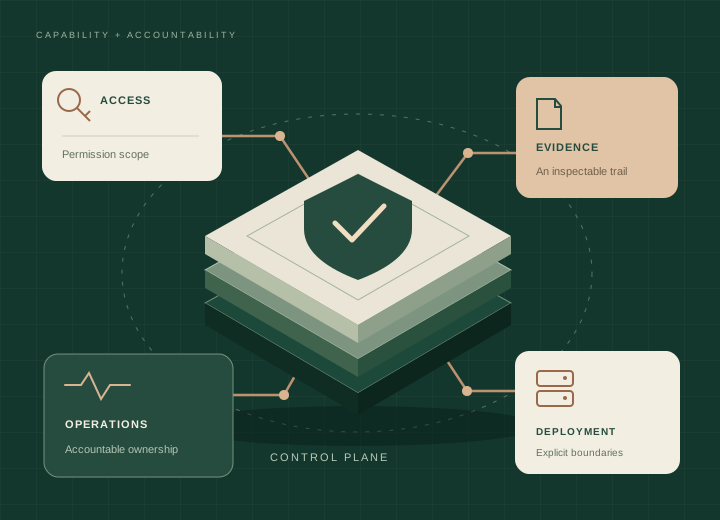
Designed around the control plane.
Concept architecture: capability surrounded by evidence, boundaries, and accountable people.
Access
Identity-aware workflows
Authentication, roles, tenant boundaries, and explicit human approval points.
Evidence
Reviewable outputs
Sources, model context, confidence, decisions, and audit history stay attached.
Deployment
Environment-conscious
Architecture adapts to residency, model, cloud, and operational constraints.
Operations
Measured after launch
Evaluation, observability, incident ownership, and handover are part of the system.
WHERE WE FOCUS
Start with a consequential workflow.
We do not begin with a generic AI platform. We begin with a decision, its evidence, and the people accountable for it.
Hamd / Illustrative workflow
01 / Enterprise operations
Teams cannot reliably find or act on internal knowledge.
Product directionHamd
Aafiya / Illustrative workflow
02 / Healthcare research
Risk scores need context, uncertainty, and explainability.
Product directionAafiya
Wathiq / Illustrative workflow
03 / Regulated onboarding
Document and identity decisions need evidence and review.
Product directionWathiq
INDUSTRIES
Designed for decisions where evidence matters.
Across healthcare, Fintech, FMCG, and industrial operations, we explore AI workflows where context is fragmented, review is consequential, and an accountable person must remain in control. These are opportunity areas, not claims of current customer deployments.
Choose a product label to highlight its sectors, or a numbered icon to jump to that sector.
Counts describe this page, not deployments, market share, or readiness. Product directions overlap, so the references do not add up to 16.
01Opportunity area
Healthcare providers
Bring conversations, personal records, visit preparation, and visible safety context into a more coherent patient experience.
Patient context
Visit preparation
Record navigation
Relevant product directionHamd · Aafiya
02Opportunity area
Life sciences and research
Explore clinical-risk signals with uncertainty, contributing factors, and evidence that researchers can inspect.
Risk research
Evidence synthesis
Explainability
Relevant product directionAafiya
03Opportunity area
Financial services
Support document and identity decisions with traceable signals, explainable verdicts, and a defined human-review path.
Identity review
Document checks
Audit evidence
Relevant product directionWathiq
04Opportunity area
Insurance
Organise intake evidence and document review without turning an automated signal into an unchallengeable decision.
Claims intake
Evidence review
Escalation
Relevant product directionWathiq · Hamd OS
05Opportunity area
Enterprise operations
Turn requests into governed work with specialist routing, owned artifacts, approvals, and durable project history.
Knowledge work
Approvals
Project memory
Relevant product directionHamd OS
06Opportunity area
Professional services
Move from a client request to a reviewable document, presentation, analysis, or project action with clear ownership.
Research workflows
Deliverables
Client knowledge
Relevant product directionHamd OS
07Opportunity area
Technology and software
Connect coding requests, implementation context, generated task documents, and pull-request review in one workflow.
Engineering agents
Pull requests
Technical memory
Relevant product directionHamd OS
08Opportunity area
Public sector
Design accountable case and document workflows around evidence, access boundaries, and explicit approval responsibility.
Case evidence
Document trust
Human oversight
Relevant product directionWathiq · Hamd OS
09Opportunity area
Education
Help teams find institutional knowledge, validate submitted documents, and keep consequential decisions with people.
Knowledge access
Document validation
Review
Relevant product directionHamd OS · Wathiq
10Opportunity area
Logistics and supply chain
Bring operational requests, exception evidence, and document checks into workflows that remain visible and reviewable.
Exception handling
Operational records
Verification
Relevant product directionHamd OS · Wathiq
11Opportunity area
FMCG and consumer goods
Explore AI-assisted demand planning, promotion analysis, and distributor knowledge with reviewable inputs and human-approved replenishment decisions.
Demand planning
Promotion analysis
Distributor knowledge
Relevant product directionHamd OS
12Opportunity area
Fintech and payments
Explore customer onboarding, payment exception handling, and fraud-case evidence with traceable document checks and human review.
Customer onboarding
Payment exceptions
Fraud-case review
Relevant product directionWathiq · Hamd OS
13Opportunity area
Retail and e-commerce
Connect product knowledge, customer questions, and inventory exceptions so teams can evaluate grounded AI support across stores and online channels.
Product discovery
Customer support
Inventory exceptions
Relevant product directionHamd OS
14Opportunity area
Manufacturing
Explore maintenance knowledge, quality evidence, and work-order triage while keeping safety-critical production decisions with qualified operators.
Maintenance knowledge
Quality review
Work-order triage
Relevant product directionHamd OS
15Opportunity area
Energy and utilities
Bring asset records, field-service requests, and regulatory documents into evidence-led AI workflows with explicit operational approval.
Asset knowledge
Field-service triage
Regulatory evidence
Relevant product directionHamd OS · Wathiq
16Opportunity area
Telecommunications
Explore network-incident triage, service knowledge, and customer-case summaries while keeping network changes and account decisions under human control.
Incident triage
Service knowledge
Customer care
Relevant product directionHamd OS
CAPABILITY MAP
Focused capabilities, connected by one operating philosophy.
Each product starts with a different workflow. They share the same commitment to clear boundaries, attached evidence, measurable quality, and accountable human decisions.
01Knowledge
Enterprise knowledge discovery
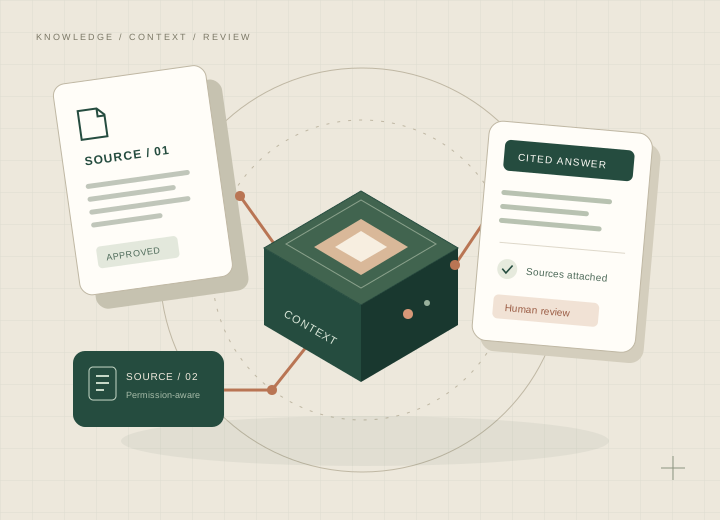
Find relevant policies, records, decisions, and operating context without losing the source behind the answer.
Combine model output with the evidence, uncertainty, policies, and review steps required for accountable decisions.
Confidence contextPolicy checksDecision records
HamdAafiyaWathiq
08Operations
Evaluation and observability
Measure quality and operational behaviour over time so teams can identify regressions, exceptions, and improvement opportunities.
Evaluation setsTrace inspectionOutcome monitoring
Platform-wide
AI SOLUTIONS GUIDE
Practical AI systems, described in plain language.
WeHamd Technologies Private Limited is an AI product company in Hyderabad, India. We build and research enterprise AI agents, RAG systems, LLM applications, healthcare AI, personal AI agents, and document verification workflows for teams that need evidence, control, and accountable human decisions.
01Agentic AI systems
Multi-agent workflows for governed enterprise work
Connect internal knowledge, specialist agents, permissioned tools, generated work, and human approvals without turning consequential decisions into a black box.
Best fit
Knowledge-heavy operations
Product path
Hamd
Current state
Active development
02RAG + GraphRAG
Grounded generation with traceable evidence
Use hybrid RAG with citations today and evaluate knowledge-graph retrieval for multi-hop questions where relationships and provenance matter.
Best fit
Policies, records, and research
Product path
Hamd
Current state
Core RAG · GraphRAG research
03Multimodal LLM applications
Language and multimodal workflows for measurable tasks
Route models by task, constrain tool use, process text and documents, produce structured outputs, and inspect traces before broader adoption.
Best fit
Drafting and task preparation
Product path
Hamd platform
Current state
Active development
04Healthcare AI research
Explainable health and risk exploration
Study uncertainty, contributing factors, and simulated scenarios while keeping research prototypes clearly separated from diagnosis or treatment.
Best fit
Research and care-team exploration
Product path
Aafiya · Sehati
Current state
Prototype · concept
05Document verification AI
Evidence-led document and identity review
Organize forensic signals, inconsistencies, reviewer context, and decision history for workflows where authenticity must remain explainable.
Best fit
Onboarding and document review
Product path
Wathiq
Current state
Functional MVP
06Privacy-first personal AI
Permissioned agents for personal work
Explore memory, planning, and approved tool use with explicit confirmation before an agent performs any consequential action.
Best fit
Daily planning and preparation
Product path
Hamdu
Current state
Under development
START WITH THE NEED
Choose a product path by the decision you need to improve.
Operational needApproachProduct
Find answers across private company knowledgeEnterprise RAG with citations and access controlsHamdPrepare work through specialized AI agentsAgent orchestration with human approval gatesHamdExplore health-risk factors transparentlyExplainable research with synthetic scenariosAafiyaReview document or identity evidenceForensic signals with a human decision pathWathiq
TECHNOLOGY FOUNDATION
A product stack built around evidence and control.
Our products combine AI capabilities with the less visible systems that make them usable in real operations: context, permissions, evaluation, observability, and accountable human review.
A reference architecture, not a claim that every integration is deployed.
01Approved data
02Context assembly
03Model reasoning
04Evidence
05Human approval
06Action
01Intelligence
Models chosen for the task
Use the right model for extraction, reasoning, classification, or generation instead of forcing every workflow through one provider.
Reasoning models
Agentic orchestration
Multimodal routing
02Context
Grounded in approved knowledge
Retrieval, permissions, citations, and freshness controls keep product responses connected to the information teams can trust.
Context engineering
Hybrid RAG
Source citations
03Data
Boundaries remain explicit
Connectors and storage are designed around tenant separation, retention rules, and the minimum data needed for each workflow.
Tenant isolation
PII / PHI controls
Retention policy
04Control
Humans stay in the decision path
Roles, approval gates, policy checks, and escalation rules define what the product may suggest, prepare, or execute.
AI guardrails
Human-in-the-loop
Policy enforcement
05Evaluation
Quality is measured continuously
Test sets, traces, feedback, and operational metrics expose regressions before a workflow expands to more teams or decisions.
LLMOps
Agent observability
Continuous evaluation
06Delivery
Built for the target environment
Deployment architecture can adapt to cloud, private-network, residency, integration, and operational ownership requirements.
Cloud + edge
Private deployment
API interoperability
EMERGING AI SYSTEMS
Advanced technology, translated into practical architecture.
We track current AI engineering patterns without presenting every new term as a finished capability. Each area below is labeled by its real place in our product and research work.
01Agentic AI
Multi-agent orchestration
Reasoning models and specialist agents plan, use approved tools, exchange structured context, and pause for human approval before consequential action.
Applied engineering
02Grounded AI
RAG and GraphRAG
Hybrid retrieval and vector search support grounded answers today; knowledge-graph retrieval is a research direction for relationship-heavy questions.
Core + research
03Open protocols
MCP and Agent2Agent interoperability
Model Context Protocol and Agent2Agent (A2A) patterns are evaluated for permissioned, auditable connections to enterprise tools and data.
Architecture direction
04Multimodal AI
Language, document, image, and vision
Multimodal workflows combine text, files, images, and structured records while preserving provenance and review boundaries.
Active research
05Efficient AI
Small models and on-device inference
Small language models, model distillation, and edge AI can improve privacy, latency, and cost for tightly bounded tasks.
Research track
06LLMOps
Evaluation and agent observability
Traces, regression suites, quality metrics, latency, cost, and drift monitoring make AI behavior measurable throughout delivery.
Applied engineering
07Responsible AI
Guardrails and AI governance
Access controls, policy checks, evidence, red-team testing, and accountable human decisions define safe operating boundaries.
Product foundation
08Digital trust
Document AI and authenticity signals
Explainable forensic signals, provenance, and review history support document and identity decisions without hiding uncertainty.
MVP + research
WEHAMD RESEARCH / 2026
Building useful intelligence.Researching what comes next.
Our research moves from production-ready LLM systems to specialized ANI and longer-horizon questions around AGI. Every horizon is labeled honestly, evaluated independently, and kept behind human control.
A map of research questions, not a claim of general intelligence.
H1Building now
LLM systems
Grounded language and multimodal systems that reason over approved context, call tools, generate structured work, and remain observable.
Multimodal models
Agentic workflows
RAG + long context
Model routing
Promotion gateReliable on a bounded workflow
H2Applied research
ANI systems
Artificial narrow intelligence optimized for a defined domain, measurable task, and controlled operating boundary rather than general autonomy.
Domain adaptation
Small language models
On-device inference
Specialist agents
Promotion gateOutperforms the current process safely
H3Research horizon
AGI questions
We study the architectures and safety questions associated with more general capabilities. We do not claim that WeHamd has built AGI.
Generalization
Continual learning
World models
Alignment research
Promotion gateEvidence before capability claims
BUILDING NOW / AUTONOMOUS RESEARCH
An agent that can investigate.Not invent the evidence.
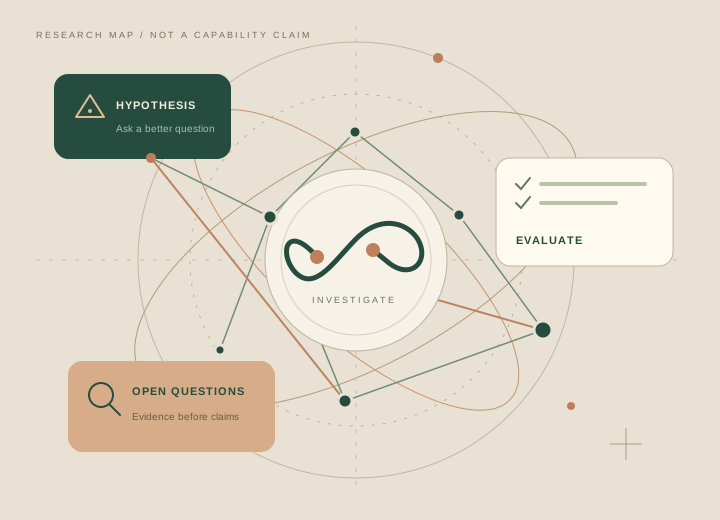
We are building an autonomous research agent for long-running, evidence-led investigation. It can break down a question, search approved sources, operate research tools, compare competing explanations, and assemble a cited report.
Permission-bounded tools Human review before release
RESEARCH AGENTPlan · act · verify
01DiscoverSearch approved sources
02GroundBuild an evidence set
03InvestigateUse models and tools
04EvaluateChallenge every result
MANDATORY CHECKPOINTHuman validates sources, reasoning, and release
01
Language intelligenceActive engineering
Reasoning with language, evidence, and tools
Study how frontier and compact language models can plan, retrieve, use tools, and produce verifiable outputs without hiding uncertainty.
LLM routing
Structured generation
Tool use
Citation fidelity
02
Multimodal systemsApplied research
Context beyond text
Combine documents, images, speech, interfaces, and structured records while preserving provenance across every modality.
Vision-language models
Speech interfaces
Document AI
Cross-modal retrieval
03
Agentic systemsActive engineering
From response generation to governed action
Explore agents that decompose work, choose tools, collaborate, recover from failure, and stop for approval before consequential action.
Planning graphs
MCP tools
Durable execution
Human checkpoints
04
Narrow intelligenceProduct research
Specialists designed to do one job well
Build ANI around explicit domain boundaries, task-specific evaluations, and smaller models where general-purpose scale is unnecessary.
Domain models
Fine-tuning
Distillation
Task-specific evaluation
05
Private intelligenceArchitecture research
Smaller models closer to the data
Investigate local and edge inference for lower latency, stronger privacy boundaries, resilience, and predictable operating cost.
SLMs
Quantization
On-device inference
Confidential compute
06
Memory and adaptationApplied research
Systems that learn without silently drifting
Separate durable knowledge, episodic memory, user preferences, and model updates so adaptation remains inspectable and reversible.
Vector memory
Knowledge graphs
Continual evaluation
Forgetting controls
07
Neuro-symbolic AIResearch track
Learning combined with explicit rules
Connect probabilistic models with policies, constraints, graphs, and deterministic verification for decisions that require both flexibility and control.
Policy engines
Constraint solving
Knowledge graphs
Formal checks
08
General intelligenceLong-horizon research
Studying transfer, abstraction, and generalization
Examine the open research questions behind systems that transfer knowledge across tasks while keeping capability claims evidence-based.
World models
Meta-learning
Causal reasoning
Generalization tests
09
AI safety scienceContinuous
Capability and control advance together
Measure hallucination, robustness, bias, misuse, privacy leakage, and loss of human control before a research result enters a product.
Red teaming
Adversarial tests
Interpretability
Incident learning
FROM RESEARCH TO PRODUCT
Novel capability is only the first gate.
01
Research signal
A repeatable result, not a single impressive demonstration.
02
Evaluation evidence
Defined test sets, baselines, failure modes, and confidence bounds.
03
Safety boundary
Known permissions, escalation paths, prohibited actions, and rollback.
04
Product fit
A real user problem with clear value beyond model novelty.
05
Operational proof
Observable performance, predictable cost, and accountable ownership.
AGI RESEARCH HORIZON / 2026
The systems AGI would need.The evidence it would have to earn.
REFERENCE RESEARCH LOOP
General capability would require more than a larger model.
A credible system would need grounded perception, predictive models, durable memory, deliberate planning, bounded action, and continuous self-evaluation under external oversight.
01PerceptionGrounded multimodal state
02World modelPredictions + causal structure
03MemoryExperience + durable knowledge
04PlanningGoals + alternatives
05ActionPermissioned tools
06ReflectionEvaluation + correction
01
ReasoningResearch direction
Reasoning that can be checked
Study systems that allocate more computation to difficult problems, expose intermediate verification signals, and revise weak conclusions.
Test-time compute
Process supervision
Verifier models
Evidence gateReasoning quality improves without hiding failure
02
World modelsResearch direction
Predict before acting
Explore internal models that represent environments, forecast consequences, and support planning beyond surface-level pattern completion.
Predictive learning
Latent dynamics
Model-based RL
Evidence gatePredictions remain calibrated under change
03
MemoryResearch direction
Learn without silently forgetting
Separate episodic, semantic, and procedural memory so knowledge can consolidate over time without uncontrolled drift or catastrophic forgetting.
Memory consolidation
Continual learning
Forgetting controls
Evidence gateAdaptation is traceable and reversible
04
PlanningResearch direction
Long-horizon action with checkpoints
Investigate hierarchical planning that decomposes goals, models dependencies, recovers from failure, and requests approval at consequential steps.
Tree search
Hierarchical plans
Credit assignment
Evidence gateLong tasks remain interruptible and recoverable
05
GroundingResearch direction
Intelligence connected to the world
Study how language, vision, audio, interfaces, and structured state can form shared representations grounded in observable evidence.
Vision-language-action
Cross-modal learning
Embodied grounding
Evidence gateClaims remain tied to observable state
06
CausalityResearch direction
Move from correlation to intervention
Research models that distinguish association from cause, answer counterfactual questions, and test interventions before recommending action.
Monitor outcomes, inspect regressions, maintain evaluation suites, document ownership, and prepare the team operating the product.
OUTPUTOperating playbook
Principles that stay fixed as the product evolves
Start narrow
Measure before scaling
Keep evidence attached
Make ownership explicit
PROOF BEFORE SCALE
A pilot should answer more than “does the model work?”
Model quality is one part of a production decision. A responsible evaluation also proves that the workflow is safe, usable, operable, and economically sensible in its intended environment.
THE EVIDENCE DESK
An evaluation you can inspect.
Sample report
Illustrative data only. Not customer results or product performance.
SCENARIO / FMCG
Demand planning review
Promotion assumptions, stock signals, and replenishment decisions.
Proceed only when evidence supports the next level of exposure.
01Targets agreed before testing
02Failures reviewed with accountable users
03Controls tested alongside capability
04Ownership accepted before production
PRODUCT FAQ
Clear answers before an evaluation begins.
Product scope, maturity, safety boundaries, and the role of human review—without inflated claims.
01
What is WEHAMD's full company name?
+
WEHAMD is the brand name of WeHamd Technologies Private Limited, an AI product company based in Hyderabad, Telangana, India. You can contact the team at azhar@wehamd.com.
02
What does WEHAMD build?
+
WEHAMD builds focused software for enterprise AI agents, retrieval-augmented generation (RAG), conversational health, explainable clinical-risk research, document verification, and digital trust. Its portfolio includes Hamd, Hamd OS, Hamdu, Aafiya, Wathiq, and the planned Sehati concept.
03
What is the difference between Hamd and Hamd OS?
+
Hamd is the iOS conversational health workspace shown on this website. Hamd OS is a separate AI operating workspace for governed requests, specialist-agent routing, generated artifacts, project history, and human approvals.
04
Does the Hamd health app provide medical advice?
+
No. The Hamd recording uses demo content and is presented as a product demonstration, not medical advice, a diagnosis, or a clinical result. Consequential health decisions should remain with qualified professionals.
05
What is Aafiya?
+
Aafiya is an explainable diabetes-progression research prototype for exploring risk, uncertainty, contributing factors, and simulated interventions. It uses synthetic data and is not clinically validated or intended for diagnosis or treatment.
06
What is Wathiq?
+
Wathiq is a document and identity-verification MVP combining forensic signals, explainable verdicts, human review, and tamper-evident audit history. Production detector hardening remains in development.
07
Which industries are WEHAMD products designed for?
+
WEHAMD explores evidence-led AI workflows across healthcare, life sciences, financial services, insurance, enterprise operations, professional services, technology, public sector, education, logistics, FMCG and consumer goods, Fintech and payments, retail and e-commerce, manufacturing, energy and utilities, and telecommunications. These are opportunity areas, not claims of current customer deployments.
08
How does WEHAMD approach responsible AI?
+
WEHAMD starts with a bounded workflow, known data, explicit human-review points, access controls, evidence, and measurable quality and safety thresholds. Automated output does not remove human accountability.
09
Which advanced AI technologies does WEHAMD explore?
+
WEHAMD works across generative AI, reasoning models, agentic AI, multi-agent orchestration, context engineering, RAG, vector search, multimodal AI, LLMOps, evaluation, observability, small language models, and responsible AI governance. GraphRAG, Model Context Protocol integrations, Agent2Agent interoperability, and on-device AI are clearly labeled as research or architecture directions where they are not yet product capabilities.
10
Has WEHAMD built artificial general intelligence?
+
No. Artificial general intelligence remains an open research horizon. WEHAMD studies relevant questions including reasoning, world models, continual learning, planning, causal inference, metacognition, interpretability, scalable oversight, and alignment without claiming to have built or released AGI.
11
How can an organisation evaluate a WEHAMD product?
+
Begin with one consequential workflow and define its users, available evidence, data boundaries, approval owner, success measures, and stopping conditions. The Plan evaluation page provides a focused starting point.
LEADERSHIP
Founder-led. Technical by design.
The people guiding WeHamd's company strategy, technology, and financial planning.
Founding team01
AMWEHAMD
AMREEN
Founder
Company direction and responsible product stewardship.
Strategy
Governance
Founding team02
RAWEHAMD
RAHILA
Founder
Company direction and responsible product stewardship.
Strategy
Governance
03Executive leadership
AZ
AZHAR
CEO
Company strategy, product direction, and business execution.
Strategy
Execution
04Executive leadership
SH
SHOAIB
CTO
Technology strategy, AI engineering, and technical standards.
Technology
Engineering
05Executive leadership
IM
IMRAN
CFO
Financial planning, budgeting, and financial oversight.
Finance
Planning
06Technical leadership
SO
SOHEL
Cloud Architect
Cloud architecture, reliability, and platform foundations.
Cloud
Reliability
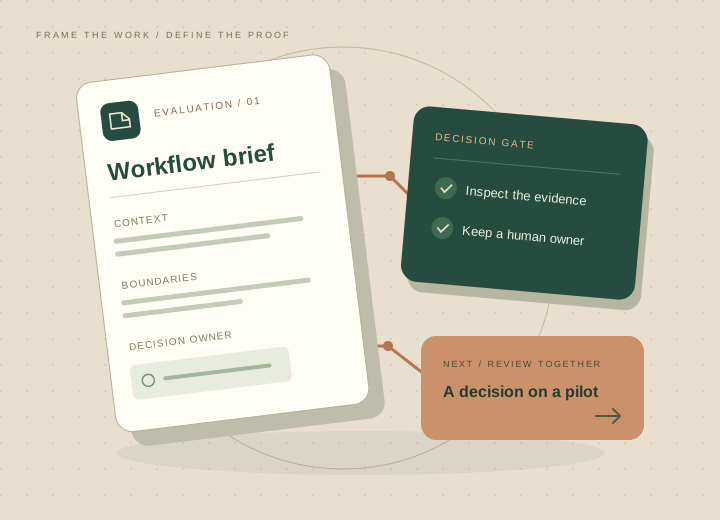
Evaluate one workflow with your team.
Start with a bounded use case. We will map data boundaries, review points, success measures, and the shortest responsible path to a working pilot.